

The Kenora Thistles, 1907

In January, 1907, a hockey team from Kenora, comprising E. Girouz (goal), A.H. Ross (point), S.I. Griffis (cover point), T. Hooper (rover), W. McGimsie (centre), R. Beaudro (right wing) and...
- toronto
- ontario
- alan brown
Kingston Post Office

In 1856-59 the government of the united Canadas erected the Kingston Post Office. Designed by the Montreal architectural firm of Hopkins, Lawford and Nelson, this limestone building shows...
- toronto
- ontario
- alan brown
The Kaministikwia Route

This chain of rivers, lakes and portages linking the St. Lawrence system with the waterways of the prairies had been known to the Indians for centuries when Jacques de Noyon first travelled it in...
- toronto
- ontario
- alan brown
Kapuskasing Internment Camp 1914-1920

When the First World War began, Canada established internment camps to detain persons viewed as security risks. Prejudice and wartime paranoia led to the needless internment of several...
- toronto
- ontario
- alan brown
Kagawong Mill 1925
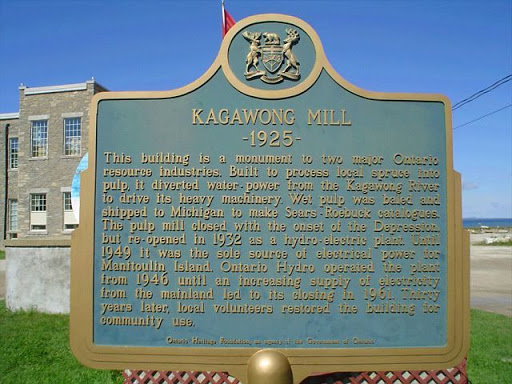
This building is a monument to two major Ontario resource industries. Built to process local spruce into pulp, it diverted water-power from the Kagawong River to drive its heavy machinery....
- toronto
- ontario
- alan brown
Johnstown District Court House and Gaol

In 1808 the provincial government authorized the erection of a court house and gaol at Elizabethtown (Brockville) to serve the District of Johnstown created ten years earlier. By 1811 a brick...
- toronto
- ontario
- alan brown
James Henry Coyne 1849-1942

Born in St. Thomas, Upper Canada, Coyne became Registrar of Deeds and, subsequently, Master of Titles, for Elgin County. Deeply interested in local history, he founded the Elgin Historical...
- toronto
- ontario
- alan brown
John A. Macdonald in Hallowell
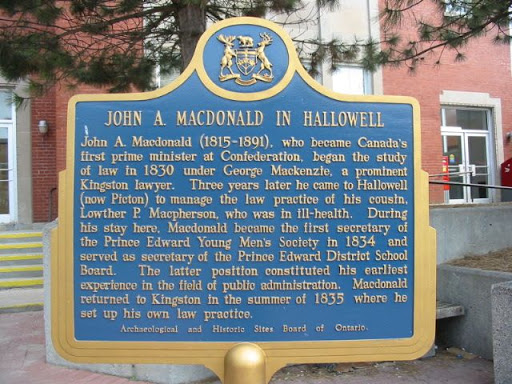
John A. Macdonald (1815-1891), who became Canada's first prime minister at Confederation, began the study of law in 1830 under George Mackenzie, a prominent Kingston lawyer. Three years later...
- toronto
- ontario
- alan brown
Jacques de Noyon 1668-1745

Jacques de Noyon was the first white man to explore this region. Born at Trois Riviéres, Noyon worked in the fur trade as a coureur de bois. In 1688 he led an expedition beyond Lake Superior into...
- toronto
- ontario
- alan brown
James Paris Lee 1831-1904

One of the foremost 19th century arms inventors, Lee was born in Scotland. In 1836 his family came to Canada and settled at Galt. Lee was trained in his father's profession of watchmaker...
- toronto
- ontario
- alan brown
Justus Sherwood 1747-1798

Born in Connecticut, Sherwood settled in Vermont in 1774. On the outbreak of the American Revolution he was arrested as a Loyalist, but escaped to join the British at Crown Point. He was taken...
- toronto
- ontario
- alan brown
Josiah Blackburn 1823-1890

The son of a Congregationalist minister, Blackburn was born in London, England. After some experience in journalism he immigrated to Canada West (now Ontario) in 1850 and joined the staff of The...
- toronto
- ontario
- alan brown
"Jake" Gaudaur 1858-1937

One of the world's greatest oarsmen, Jacob Gill Gaudaur grew up just east of here Atherley Narrows at a time when rowing was one of the most popular sports in North America. In 1892, a crowd...
- toronto
- ontario
- alan brown
James Wallis 1806-1893

This house, "Maryboro' Lodge", was completed in 1837 by James Wallis, a gentleman from "Maryborough", Cork, Ireland, who had emigrated to Montreal in 1832. The following year he and Robert Jameson...
- toronto
- ontario
- alan brown
Josiah Henson (1789-1883)

After escaping to Upper Canada from slavery in Kentucky, the Reverend Josiah Henson became a conductor of the Underground Railroad and a force in the abolition movement. The founder of the Black...
- toronto
- ontario
- alan brown
John Brown's Convention 1858
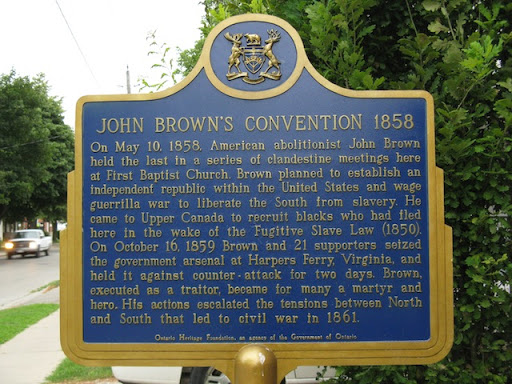
On May 10, 1858, American abolitionist John Brown held the last in a series of clandestine meetings here at First Baptist Church. Brown planned to establish an independent republic within...
- toronto
- ontario
- alan brown
John Muir 1838-1914

Born in Dunbar, Scotland, this famous naturalist, whose books and articles played a significant role in the early development of the United States National Park Service, emigrated with his...
- toronto
- ontario
- alan brown
James Jerome Hill 1838-1916

Born near Rockwood, Upper Canada, Hill moved to Minnesota in 1856 settling at St. Paul. Having organized the Red River Transportation Company which provided effective transportation between St....
- toronto
- ontario
- alan brown
James Keating c.1786-1849

A sergeant in the Royal Artillery, Irish-born James Keating served with distinction during the War of 1812. His skilful handling of a British field gun forced the Americans to surrender...
- toronto
- ontario
- alan brown
John Wesley Dafoe 1866-1944
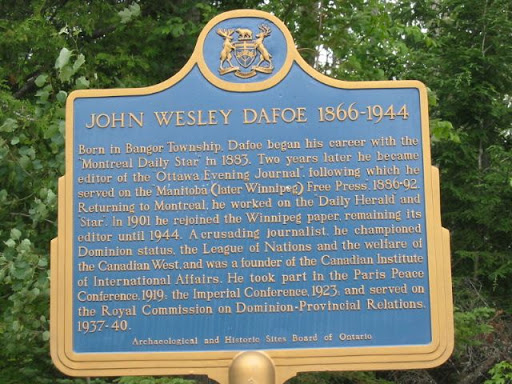
Born in Bangor Township, Dafoe began his career with the "Montreal Daily Star" in 1883. Two years later he became editor of the "Ottawa Evening Journal" following which he served on the "Manitoba...
- toronto
- ontario
- alan brown