

St. Andrew's Market and Playground

This city block was set aside in 1837 for a public market, the third of its kind after the St. Lawrence (1803) and St. Patrick's (1836) Markets. Built in 1850 and eventually named "St....
- toronto
- ontario
- alan brown
Saint Josaphat's Ukrainian Catholic Cathedral

Dedicated in 1914, St. Josaphat's is the city's earliest Ukrainian Catholic Institution. It was founded by the immigrants from western Ukraine who came to Toronto in the early 1900s. Settling...
- toronto
- ontario
- alan brown
The Stables of Sir Henry Mill Pellatt's Casa Loma

The northern part of the Casa Loma Estate, comprising the Hunting Lodge, Potting Shed, Greenhouses and the Stables complex was begun in 1905 by builder Herbert Elgie, according to the design of...
- toronto
- ontario
- alan brown
Sir Daniel Wilson 1816-1892

A scholar of diverse interests and talents, Daniel Wilson was noted in Britain as the author and illustrator of studies of old Edinburgh and of Scottish prehistory. In 1853 he was appointed to the...
- toronto
- ontario
- alan brown
Sir Byron Edmund Walker (1848-1924)

A recognized international authority on banking, Walker was general manager of the Canadian Bank of Commerce from 1886 and its president, 1907-1924. His love of the arts and interest in...
- toronto
- ontario
- alan brown
Scarborough Rifle Company Marching to the Niagara Frontier

In 1862 the Scarborough Rifle Company was organized with headquarters in a school at Eglinton Avenue near Markham Road. It was the first of several militia companies formed in York County. The...
- toronto
- ontario
- alan brown
St. Stephen-In-The- Fields Anglican Church

A fine example of Gothic Revival architecture in the style of early English parish churches, St. Stephen-in-the-Fields, named for its original rural setting, represents the work of two...
- toronto
- ontario
- alan brown
The Story Behind 672 Dupont

Faema's current headquarters sits on the corner of Dupont and Christie in Toronto's West End. The structure, originally constructed by Ford, possesses a rich history dating back to The First World...
- toronto
- ontario
- alan brown
Scadding Cabin

John Scadding (1754-1824), the manager of Lieutenant Governor John Graves Simcoe's Estate in Devonshire, arrived in Canada in 1792, and came to York with Simcoe the following year. He was granted...
- toronto
- ontario
- alan brown
The Studio Building

The construction of the Studio Building for Canadian art was commissioned by renowned Canadian artist Lawren Harris (1885-1970), an heir to the Massey-Harris farm machinery fortune, and...
- toronto
- ontario
- alan brown
Stone Church Site of Jesse Ketchum Hall

Jesse Ketchum (1780-1867) was a tanner, politician and generous public benefactor in the town of York. He helped to establish churches, schools and libraries. A life long opponent of the use...
- toronto
- ontario
- alan brown
St. Michael's Cathedral Rectory
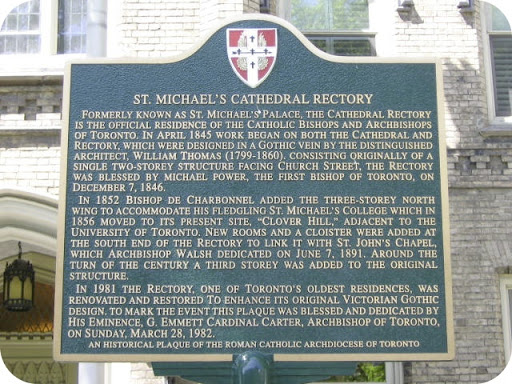
Formerly known as St. Michael's Palace, the Cathedral Rectory is the official residence of the Catholic Bishops and Archbishops of Toronto. In April 1845 work began on both the Cathedral...
- toronto
- ontario
- alan brown
St. Hilda's College

St. Hilda's was founded in 1888 as a women's college affiliated with the University of Trinity College. Opportunities at that time for a higher education for women in Canada were few....
- toronto
- ontario
- alan brown
St. Matthew's Lawn Bowling Clubhouse

St. Matthew's Lawn Bowling Clubhouse was, for more then a century, a local landmark and sports facility. Founded in 1899, it was one of several lawn bowling clubs that appealed to genteel Toronto...
- toronto
- ontario
- alan brown
Sir John A. Macdonald Plaza

Upon the confederation of Canada on July 1, 1867, Sir John A. Macdonald (1815-1891) became Canada's first prime minister. His government completed construction of the transcontinental...
- toronto
- ontario
- alan brown
St. Michael's Hospital

St. Michael's Hospital opened on this site in 1892 in a Baptist church which had been converted into a women's boarding house by the Sisters of St. Joseph. The hospital opened with 26 beds,...
- toronto
- ontario
- alan brown
Sir James Pliny Whitney 1843-1914

Born in Williamsburg Township, Dundas County, and educated at the Cornwall Grammar School, Whitney was called to the Bar in 1876. He was elected to the Provincial Parliament as Conservative...
- toronto
- ontario
- alan brown
Sir William Pearce Howland (1811-1907)
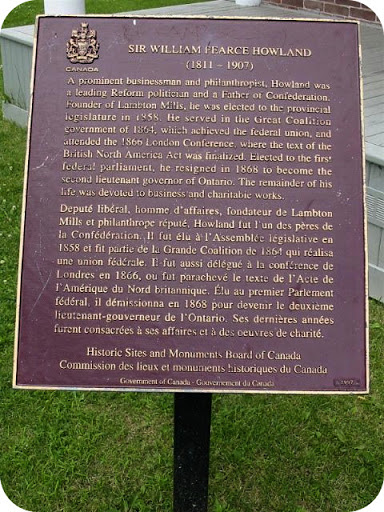
A prominent businessman and philanthropist, Howland was a leading Reform politician and a Father of Confederation. Founder of Lambton Mills, he was elected to the provincial legislature in 1858....
- toronto
- ontario
- alan brown
St. Michael's Cathedral

The cornerstone of St. Michael's Cathedral was laid on May 8, 1845, by the Most Reverend Michael Power, first Catholic Bishop of Toronto. Designed by William Thomas, the building is an...
- toronto
- ontario
- alan brown
Spadina Expressway

Spadina ExpresswayIn the 1960s, this stretch of Spadina Road was to be transformed into the southern end of a sunken, four- to six-lane expressway and a subway line. They would connect downtown...
- toronto
- ontario
- alan brown