

David Brown Milne 1882-1953

One of Canada's outstanding artists, Milne was born on a farm near Burgoyne, Saugeen Township, and raised in Paisley. Though largely self-taught, he studied briefly in New York at the...
- toronto
- ontario
- alan brown
District Court House and Gaol

When the British withdrew from Detroit in 1796, they transferred the courts of the Western District to Sandwich (Windsor). An abandoned blockhouse, relocated from Chatham, served briefly as the...
- toronto
- ontario
- alan brown
The Destruction of the Caroline, 1837

On the night of December 29-30, 1837, some 60 volunteers acting on the orders of Col. Allan Napier MacNab, and commanded by Capt. Andrew Drew, R.N., set out from Chippawa in small boats to capture...
- toronto
- ontario
- alan brown
Dixie Union Chapel

Constructed of stone from the nearby Etobicoke River, this building also known as the Stone Chapel, is a rare surviving example of a "union" chapel from the settlement period of Upper Canada. It...
- toronto
- ontario
- alan brown
Daniel David Palmer (1845-1913)

Raised in Port Perry, D.D. Palmer was self- educated, well read and keenly interested in spiritualism and alternative medicine. While working as a magnetic healer in the United States, his...
- toronto
- ontario
- alan brown
Daniel Fowler 1810-1894

In this house Daniel Fowler, a well known nineteenth century Canadian artist, lived for over forty years. Born in England he first took up law, but on the death of his father studied art under the...
- toronto
- ontario
- alan brown
The Dawn Settlement

In the 1830s, the Reverend Josiah Henson and other abolitionists sought ways to provide refugees from slavery with the education and skills they needed to become self-sufficient in Upper Canada....
- toronto
- ontario
- alan brown
District Court-House and Gaol 1832

An Act of the legislature of Upper Canada in 1831 named Prince Edward County a separate judicial district. Land for a court-house in Picton was given by the Rev. William Macauley and construction...
- toronto
- ontario
- alan brown
Dr. Henry Norman Bethune 1890-1939

An internationally-famed humanitarian, surgeon and revolutionary, Bethune was born in this house. He graduated from the University of Toronto's medical school during the First World War and...
- toronto
- ontario
- alan brown
Dundurn Castle
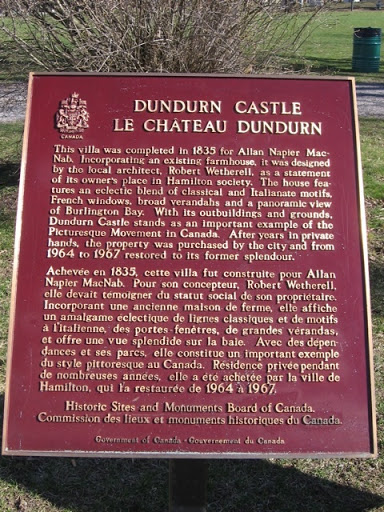
This villa was completed in 1835 for Allan Napier MacNab. Incorporating an existing farmhouse, it was designed by the local architect, Robert Wetherell, as a statement of its owner's place...
- toronto
- ontario
- alan brown
District Court-House and Gaol 1833

The central portion of this building was completed in 1833 and served as the court-house and gaol of the Eastern District. First named Luneburgh, this district was established in 1788 by...
- toronto
- ontario
- alan brown
The Dale Estate

The Dale Estate nurseries played an instrumental role in the development of Brampton, establishing its reputation as "The Flower Town of Canada." The business began in 1863 with its founder...
- toronto
- ontario
- alan brown
"Dundas Mills"

By 1799 the Morden family had a sawmill near this site on Spencer Creek north of Dundas Street. They sold this property in 1800 to Edward Peer who built a grist-mill about 275 metres...
- toronto
- ontario
- alan brown
Douglas Point Nuclear Power Plant

The Douglas Point Nuclear Power Plant began generating electricity in 1967 and continued until 1984. This joint project between Atomic Energy of Canada Ltd. and Ontario Hydro was the...
- toronto
- ontario
- alan brown
The Disappearing Propeller Boat

Popularly known as the Dispro, or Dippy, this small boat was first built on this site in 1916 by the Disappearing Propeller Boat Company Limited. Also manufactured elsewhere in Ontario and...
- toronto
- ontario
- alan brown
Dundurn Castle 1832

This mansion was built 1832-35 by Allan Napier MacNab (1798-1862) and named after the family ancestral seat in Scotland. Enlisting at fifteen, MacNab distinguished himself by his bravery in...
- toronto
- ontario
- alan brown
District Court House and Jail

In 1838 the District of Colborne was established and Peterborough selected as the "district town". In June of that same year, the district magistrates, with the Hon. Thomas Stewart presiding,...
- toronto
- ontario
- alan brown
The Dalhousie Library

In 1828, eight years after the original settlement of this area, the St. Andrew's Philanthropic Society founded the first public library within the old Bathurst District. A log building, known as...
- toronto
- ontario
- alan brown
Darlingside

Darlingside is a rare surviving example of the wood depots which provided an essential fuelling service during the early phase of steamboat navigation on Lake Ontario and the upper St. Lawrence...
- toronto
- ontario
- alan brown
The Desjardins Canal

In pioneer days waterways provided the essential means of transportation. Dundas, located at the head of navigation on Lake Ontario and the eastern terminus of the "Governor's Road", was thus in...
- toronto
- ontario
- alan brown