

Hiram Walker, 1816-1899

Massachusetts born, Hiram Walker had by the 1850s become a successful general merchant, distiller and grain dealer in Detroit. After Michigan adopted prohibition in 1855 he acquired land across...
- toronto
- ontario
- alan brown
The Hillary House

This house was built in 1861-62 for Dr. Walter B. Geikie, a prominent medical teacher, who lived here from 1862 to 1869. Although altered by subsequent owners in 1869 and 1888, it remains one of...
- toronto
- ontario
- alan brown
Harriet Tubman (c.1822-1913)

Born on a Maryland plantation, Harriet Tubman escaped slavery to become one of the great heroes of the 19th century. The most famous "conductor" on the Underground Railroad, she courageously...
- toronto
- ontario
- alan brown
Government House 1832

Alwington House, which stood on this site, was completed in 1832 by Charles W. Grant, fifth baron of Longueuil. It was enlarged in 1841 to serve as the vice-regal residence during the period...
- toronto
- ontario
- alan brown
Griffin House

Built in 1827, this home is associated with Black settlement in British North America during the first half of the 19th century. Purchased in 1834 by Enerals Griffin, a Black immigrant...
- toronto
- ontario
- alan brown
Glengarry Landing

At the forks of the Nottawasaga River, Lt.-Col. Robert McDouall, Glengarry Light Infantry, built the flotilla of boats with which he effected the relief of the British garrison at...
- toronto
- ontario
- alan brown
George Herbert Locke 1870-1937

Born at Beamsville and educated at Victoria College and the University of Toronto, Locke taught at Toronto, Chicago and Harvard Universities and was Dean of Education at Chicago and at MacDonald...
- toronto
- ontario
- alan brown
Glengarry Emigration of 1786

Early in September, 1786, a group of some 500 Scottish Highlanders, the majority of whom were Macdonells, arrived at Quebec. They were led by their parish priest from Knoydart, Glengarry,...
- toronto
- ontario
- alan brown
Gull River and the Clergy House

This site was an early Indian camping ground, the Gull River watershed being the hunting territory of bands living around Lake Simcoe who came by way of the Balsam Lake portage and Gull River...
- toronto
- ontario
- alan brown
The Geraldton Gold Camp

Discoveries of gold in the vicinity of Lake Kenogamisis in 1931-2 mushroomed into an extensive gold-mining field in this region. Prospector Tom Johnson, mining promoter Joseph Errington...
- toronto
- ontario
- alan brown
The "Grover- Nicholls" House
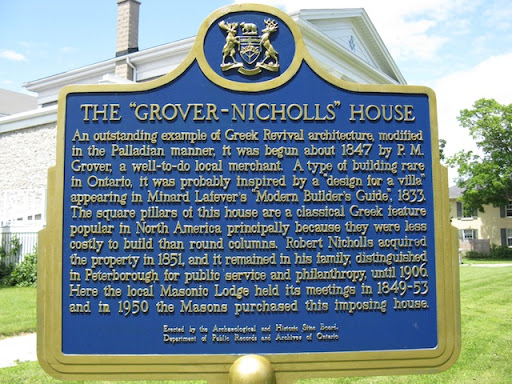
An outstanding example of Greek Revival architecture modified in the Palladian manner, it was begun about 1847 by P.M. Grover, a well-to-do local merchant. A type of building rare in Ontario, it...
- toronto
- ontario
- alan brown
Grand River Naval Depot 1815

In 1815 the Royal Navy began building a depot on the present site of Port Maitland. Though intended in the event of war to accommodate three frigates and 1,000 men, the base actually supported...
- toronto
- ontario
- alan brown
Guelph City Hall 1856

This fine example of classical architecture was begun in 1856 following the incorporation of Guelph as a town. It was designed by William Thomas, architect of St. Lawrence Hall, Toronto, and other...
- toronto
- ontario
- alan brown
Great Dog Portage

This portage was one of the steepest on the Kaministiquia canoe route between Lake Superior and the West. First recorded in 1688 by the French explorer Jacques de Noyon, it was abandoned...
- toronto
- ontario
- alan brown
Gateway to Huronia

From this lookout may be seen the bay which, during the first half of the 17th century, formed the western terminus of the 1280 km route connecting New France with the Huron settlements. Heavily...
- toronto
- ontario
- alan brown
The Grand River Mission

The establishment of this mission in 1822 began Methodist missionary work among the province's Indians, and the following year the Reverend Alvin Torry organized the first congregation at...
- toronto
- ontario
- alan brown
Gananoque

A vulnerable point on the vital line of supply from Lower Canada in the war of 1812-14, Gananoque was raided on the 21 September, 1812, when the bridge was destroyed. Subsequently fortified by the...
- toronto
- ontario
- alan brown
Galt City Hall

This attractive public building was designed and built in 1857-8 by H.B. Sinclair, a local resident, as a "Town Hall and Market House". Galt had become an incorporated town on January 1, 1857, and...
- toronto
- ontario
- alan brown
Guelph Public Library

One of the first municipally supported libraries formed in Ontario following passage of the Free Libraries Act of 1882, the Guelph Public Library was established on February 10, 1883. It...
- toronto
- ontario
- alan brown
Grey Owl 1888-1938

Born and educated in Hastings, Archibald Stansfeld Belaney early became fascinated with the North American Indians and their way of life. Emigrating to Canada in 1906, he spent most of the...
- toronto
- ontario
- alan brown