

The Founding of Uxbridge

The settlement of this area was stimulated by the arrival about 1806 of approximately twelve Quaker families from Pennsylvania. About 1808 Joseph Collins completed the first saw and...
- toronto
- ontario
- alan brown
The Founding of Brantford

In the 1820's significant improvements to the Hamilton and London road attracted settlers to the Indian lands at Brant's Ford where this thoroughfare crossed the Grand River. A thriving village...
- toronto
- ontario
- alan brown
Formation of the Methodist Church (Canada, Newfoundland, Bermuda) 1884

The largest Protestant denomination in Canada during the late 19th and early 20th centuries, the Methodist Church (Canada, Newfoundland, Bermuda) was established in 1884. Its formation marked...
- toronto
- ontario
- alan brown
The Founding of Stouffville
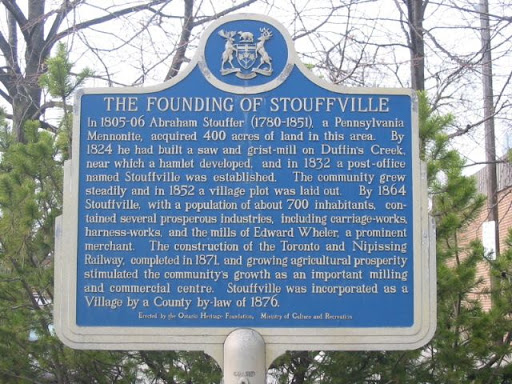
In 1805-06 Abraham Stouffer (1780-1851), a Pennsylvania Mennonite, acquired 160 ha of land in this area. By 1824 he had built a saw and grist- mill on Duffin's Creek, near which a...
- toronto
- ontario
- alan brown
Former Geological Survey of Canada Building

This mid-19th century hotel was remodeled in 1881 as the first Ottawa home of the Geological Survey of Canada. The Survey, established in 1842 to map the country's natural resources, became a...
- toronto
- ontario
- alan brown
The Founding of Oliver Township

In the late 1860s the need to develop a local agricultural base to serve a growing population of the Thunder Bay region became apparent, and when the 1873 survey of Oliver Township indicated...
- toronto
- ontario
- alan brown
The Founding of Madoc

Mills constructed about 1832 by Donald MacKenzie, a Belleville merchant, and the ironworks erected by American entrepreneurs Uriah Seymour and John Pendergast, formed the nucleus of a...
- toronto
- ontario
- alan brown
Fort St. Joseph

When the British withdrew from Michilimackinac in 1796 they moved to this island, where they build the most westerly of the British military posts. The troops were accompanied by officers of...
- toronto
- ontario
- alan brown
The Founding of Dresden

In 1846 Daniel van Allen, a Chatham merchant, laid out a town plot on land purchased from Jared Lindsley, the first settler (1825) on the site of Dresden. By 1849 the erection of a steam...
- toronto
- ontario
- alan brown
Founding of Georgetown

After British officials acquired a block of land from the Mississaugas in 1818, the initial survey of Esquesing Township was undertaken in 1819. A township surveyor, Charles Kennedy, and several...
- toronto
- ontario
- alan brown
Fort William

In aboriginal times the Kaministikwia river was an important link between the Great Lakes and the northwest, and from the late 17th century French posts here at its mouth served as bases for...
- toronto
- ontario
- alan brown
The Founding of Port Elgin

Port Elgin's development began when, in 1854, Benjamin Shantz, one of Saugeen Township's early settlers, acquired from George Butchart a sawmill on Mill Creek. Nearby he built a grist-mill...
- toronto
- ontario
- alan brown
Fort Wellington

The first Fort Wellington was erected on this site during the War of 1812 to shelter British regular troops and Canadian Militia defending the vital St. Lawrence River transportation route....
- toronto
- ontario
- alan brown
Fairfield House

This is one of few eighteenth-century Loyalist residences remaining in Ontario. William and Abigail Fairfield were among the first Loyalists to settle this area after the American Revolution. They...
- toronto
- ontario
- alan brown
The Founding of Osgoode Township

Named for William Osgoode, the first Chief Justice of Upper Canada, Osgoode Township was established on lands the British acquired from the Mississaugas in the 1780s. Land for farming and...
- toronto
- ontario
- alan brown
The Founding of Omemee

About 1820 Maurice Cottingham settled here on the Pigeon River in Emily Township. By 1835 his family had acquired much of the site of the present village. William Cottingham had built mills...
- toronto
- ontario
- alan brown
The Founding of Thedford
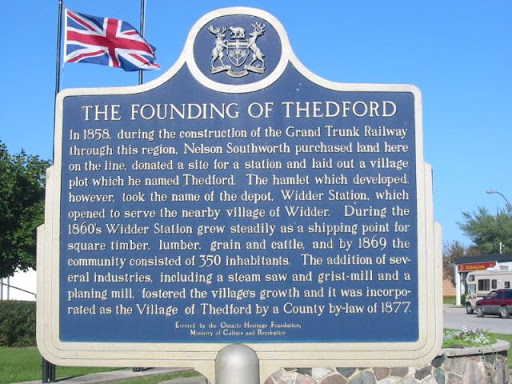
In 1858, during the construction of the Grand Trunk Railway through this region, Nelson Southworth purchased land here on the line, donated a site for a station and laid out a village plot named...
- toronto
- ontario
- alan brown
Founding of Burritt's Rapids

In 1793 Stephen and Daniel Burritt, two brothers from Arlington, Vermont, settled in this vicinity. A bridge, sawmill and school were built here at "Daniel Burritt's Rapids" before 1826. In...
- toronto
- ontario
- alan brown
The First Welland Canal 1824-1833

Lock number 6 of the original Welland Canal lies in the adjacent watercourse about 213 metres south-west of here. This first or "wooden" canal, constructed 1824-33 by the Welland Canal...
- toronto
- ontario
- alan brown
Edward Blake 1833-1912

Lawyer, leading member of the Canada First movement, and statesman, Edward Blake was born in Middlesex County, Upper Canada. He was the second premier of Ontario (1871-2) and a member of the House...
- toronto
- ontario
- alan brown