

The Village of Yorkville

The coat of arms above is from the Yorkville Town Hall, built on Yonge Street in 1859. It contains symbols representing the occupations of the first councillors: John Severn, Brewer; Thomas...
- toronto
- ontario
- alan brown
Vincent Massey 1887-1967

Vincent Massey, diplomat, philanthropist and patron of the arts, was born in Toronto and educated at the University of Toronto and Oxford. He served as Canada's first Minister to...
- toronto
- ontario
- alan brown
Victoria Memorial Square

Early YearsPart of the Fort York National Historic Site, this park shelters the city's earliest known cemetery to be established by British authorities. In 1794, shortly after the founding of the...
- toronto
- ontario
- alan brown
Village of Yorkville/Yorkville Town Hall

Village of YorkvilleOnce crossed by an ancient aboriginal trail (Davenport Road), the area known today as Yorkville was first permanently settled by those of European descent in the early...
- toronto
- ontario
- alan brown
Upper Canada College

Believing in the need for a preparatory school to serve the projected and much-debated provincial university, John Colborne, the newly-appointed lieutenant-governor of Upper Canada, secured...
- toronto
- ontario
- alan brown
United Drug Company 1914

This five-storey building was constructed for the United Drug Company. From 1920 until 1943, L.K. Liggett Druggists ran a pharmacy and soda fountain on the ground floor. A condominium...
- toronto
- ontario
- alan brown
University College

The building of University College in 1856-59 largely assured the future of the University of Toronto and drew it, in time, into a federal pattern which was widely followed in Canada and the...
- toronto
- ontario
- alan brown
Union Station

This station was built between 1915 and 1920 to the designs of Ross and Macdonald, H.G. Jones and J.M. Lyle. Subsequent to the relocation of the tracks, it was opened in 1927. It is the...
- toronto
- ontario
- alan brown
University Avenue Armouries

On this site stood the University Avenue Armouries, the home of famous Toronto Regiments of the Canadian Army and the centre of Militia activities in Toronto from 1891 until it was demolished in...
- toronto
- ontario
- alan brown
Ukrainian Internments at Stanley Barracks

Thousands of Ukrainians and other Europeans were needlessly imprisoned as "enemy aliens" during Canada's national internment operations of 1914-1920. The Stanley Barracks Receiving Station was...
- toronto
- ontario
- alan brown
University Club of Toronto Building 1929

Founded in 1906 as a private dining club for those with a university degree, the University Club of Toronto moved to this location on Toronto's ceremonial avenue in 1929. A design competition for...
- toronto
- ontario
- alan brown
Upper Canada College Boarding House

This is the last remaining building of Upper Canada College, located here 1831-1891. Built in the Georgian style in 1833, the student residence was altered and enlarged first in 1856 by Cumberland...
- toronto
- ontario
- alan brown
Loudon County Courthouse

Submitted by @jqmcd.
- loudon
- virginia
Trinity College

The University of Trinity College was located on this site 1852-1925, occupying a large Gothic- Revival building designed by Kivas Tully with later additions by Frank Darling. Trinity was founded...
- toronto
- ontario
- alan brown
Todmorden Mills

In 1794-5 Isaiah and Aaron Skinner built a sawmill and grist-mill near this site. A third share in the mill property was held, 1799-1805, by their brother-in-law, Parshall Terry, a member of...
- toronto
- ontario
- alan brown
Toronto's Historic Waterfront - Harbourfront Centre

This view shows the current 4 ha Harbourfront Centre site as it appeared in April, 1929. At the top of the photo is what was then the largest single unit warehouse in North America, the Toronto...
- toronto
- ontario
- alan brown
The Toronto Normal and Model School 1851-1962

This central facade has been left standing to commemorate the long and close association of St. James Square with education in the Province of Ontario. Here Egerton Ryerson superintended the work...
- toronto
- ontario
- alan brown
The Thomson Settlement
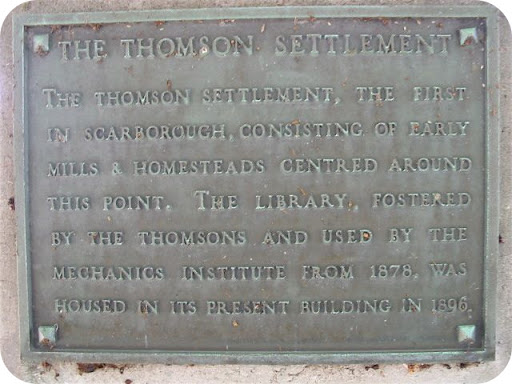
The Thomson Settlement, the first in Scarborough, consisted of early mills & homesteads centred around this point. The library, fostered by the Thomsons and used by the Mechanics Institute...
- toronto
- ontario
- alan brown
The Types Riot

The printing offices of William Lyon Mackenzie's controversial weekly newspaper, The Colonial Advocate (1824-34), were located on this site in 1826. That year on June 8 a group of young men broke...
- toronto
- ontario
- alan brown
Toronto's New City Hall
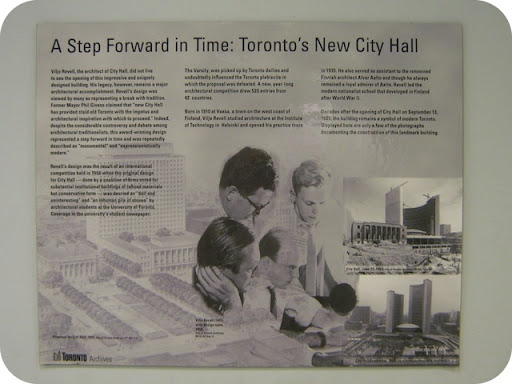
Viljo Revell, the architect of City Hall, did not live to see the opening of this impressive and uniquely designed building. His legacy, however, remains a major architectural...
- toronto
- ontario
- alan brown