
Paul Peel 1860-1892

Born in London, Ontario, Peel became one of the most prominent Canadian painters of the French academic school of painting and among the first to gain an international reputation. He studied...
- toronto
- ontario
- alan brown
The Parish of St. Raphael

A mission of the Roman Catholic Highlanders of the Raisin River settlement was begun in 1786 by the Reverend Alexander Macdonell (Scotus) and later a small frame church, called the "Blue Chapel"...
- toronto
- ontario
- alan brown
1860 Paul Peel 1892
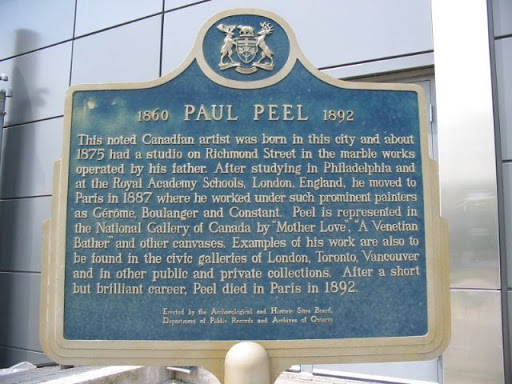
This noted Canadian artist was born in this city and about 1875 had a studio on Richmond Street in the marble works operated by his father. After studying in Philadelphia and at the Royal...
- toronto
- ontario
- alan brown
The Pembroke and Mattawan Road

Constructed primarily as a supply route to the lumber camps in the Upper Ottawa Valley, this Colonization Road was begun in 1853 and opened the following year as a winter road from Pembroke to the...
- toronto
- ontario
- alan brown
Perth Town Hall

Perth's stately town hall is an enduring expression of the vitality and importance of local governments in the 19th century. Erected in 1863-1864, shortly after the town's incorporation, it...
- toronto
- ontario
- alan brown
"Pirate" Johnston 1782-1870
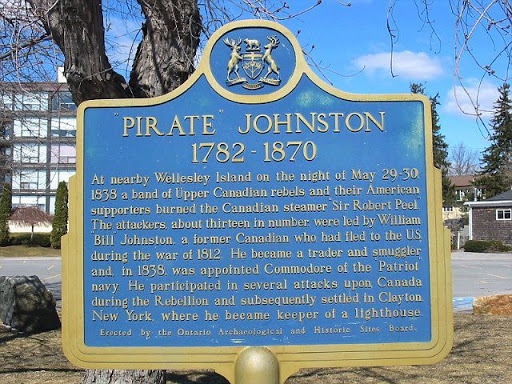
At nearby Wellesley Island on the night of May 29-30, 1838 a band of Upper Canadian rebels and their American supporters burned the Canadian steamer "Sir Robert Peel". The attackers,...
- toronto
- ontario
- alan brown
The Pic

The mouth of the Pic River has been the centre of native trade and settlement for thousands of years. It was a strategic location in the region's water transportation network because it...
- toronto
- ontario
- alan brown
Public Grounds of the Parliament Buildings

In 1873 the Department of Public Works contracted with New York landscape architect Calvert Vaux to design a plan for the public grounds of Parliament Hill. Superseding a design by the English...
- toronto
- ontario
- alan brown
Pain Court

Settlement of this region began in the 1780s when English and French-speaking squatters from the Detroit area moved on to the Indian lands along the lower Thames River. By the 1820s in the...
- toronto
- ontario
- alan brown
Penetanguishene

The Attignawantan ("Bear Nation") of the Huron confederacy occupied the Penetanguishene peninsula prior to their dispersal in 1649 by the Iroquois. In 1793 Lieutenant-Governor Simcoe...
- toronto
- ontario
- alan brown
The Perth Road

This road was surveyed in 1852 to encourage settlement of the isolated townships lying between Kingston and Perth. It was begun and completed as far as Loughborough Lake in 1854 by the Kingston...
- toronto
- ontario
- alan brown
Point Mississauga Lighthouse

The first lighthouse on the Great Lakes was built of stone at Point Mississauga in 1804 by John Symington, under orders from Lieutenant-Governor Peter Hunter. Demolished in 1814 to make room...
- toronto
- ontario
- alan brown
Port Arthur

On Thunder Bay just north of Fort William, engineer Simon Dawson established the eastern terminus of the Canadian government's proposed land and water route connecting Lake Superior and the Red...
- toronto
- ontario
- alan brown
Port Burwell Lighthouse 1840

The Port Burwell lighthouse was constructed in 1840. It was part of a national network of light stations equipped with beacon lights to warn or guide ships at sea. The Port Burwell light was used...
- toronto
- ontario
- alan brown
The Parliament Buildings

In 1859 the province of Canada began to erect its Parliament buildings. The architectural competition was won by Fuller & Jones for the legislative building and by Stent & Laver for the east and...
- toronto
- ontario
- alan brown
Perth Military Settlement 1816

The present townships of Bathurst, Beckwith and Drummond were settled under the jurisdiction of the Quarter Master General's Department. Scottish emigrants, quartered in barracks at...
- toronto
- ontario
- alan brown
Peterborough Petroglyphs

Situated on an outcrop of white marble on the Canadian Shield, the Peterborough Petroglyphs site is one of the largest know concentrations of prehistoric rock carvings in Canada. Several hundred...
- toronto
- ontario
- alan brown
The Portage Road

This road follows the general route of the Indian portage from Lake Simcoe to Balsam Lake. The portage was first mapped by the Honourable John Collins, Deputy Surveyor General of Canada, when he...
- toronto
- ontario
- alan brown
Parkwood

A rare surviving example of the grand estates of the inter-war years, Parkwood consists of a richly decorated house set in 5 ha of grounds. The house, originally constructed in 1916-1917 to the...
- toronto
- ontario
- alan brown
Port Stanley

Kettle Creek was called by the Iroquois the "Kanagio", by the Ojibwas the "Akiksibi", by the French the "Riviére Tonti". Among early visitors were: Louis Jolliet, September, 1669; Dollier...
- toronto
- ontario
- alan brown