

The Founding of Iroquois Falls

This region's first inhabitants were aboriginal peoples who were attracted by its abundant natural resources and extensive water routes. Europeans arrived in the late 1600s to acquire furs...
- toronto
- ontario
- alan brown
The Founding of Almonte

The sawmill and grist-mill completed here on the Mississippi River in 1823 by Daniel Shipman provided a nucleus around which a community known as Shipman's Mills had developed by 1824. About 1850...
- toronto
- ontario
- alan brown
The First Provincial Parliament 1792

On September 17, 1792, John Graves Simcoe, Lieutenant-Governor of Upper Canada, opened in this community, then the capital, the first provincial parliament. The legislature consisted of an...
- toronto
- ontario
- alan brown
Founding of New Liskeard

The Little Clay Belt, the rich agricultural belt extending north from New Liskeard, was originally inhabited by the Algonquin First Nations, including Joachim "Clear Sky" Wabigijic and...
- toronto
- ontario
- alan brown
Fighting Island 1838
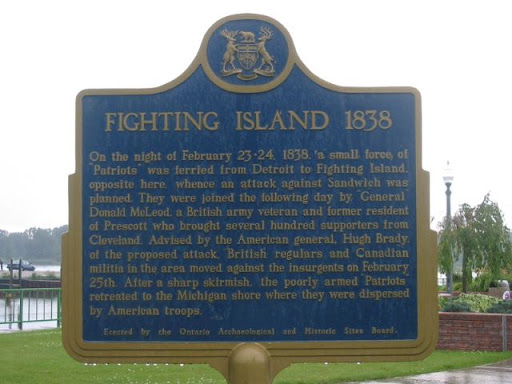
On the night of February 23-24, 1838, a small force of "Patriots" was ferried from Detroit to Fighting Island, opposite here, whence an attack against Sandwich was planned. They were joined...
- toronto
- ontario
- alan brown
The Founding of Bolton
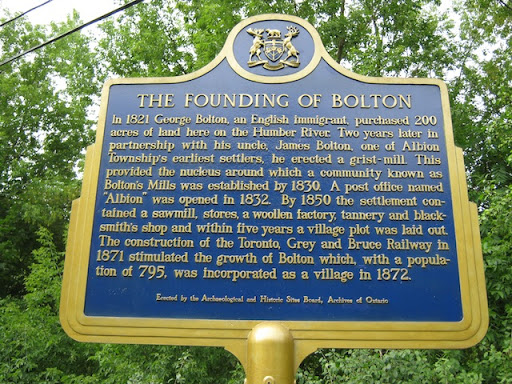
In 1821 George Bolton, an English immigrant purchased 80 ha of land here on the Humber River. Two years later in partnership with his uncle, James Bolton, one of Albion Township's...
- toronto
- ontario
- alan brown
Former Brockville Post Office

Completed in 1886 this structure was designed under the direction of Thomas Fuller, Chief Architect of the Department of Public Works from 1881 to 1896. The Brockville Post Office shows...
- toronto
- ontario
- alan brown
Fort Erie
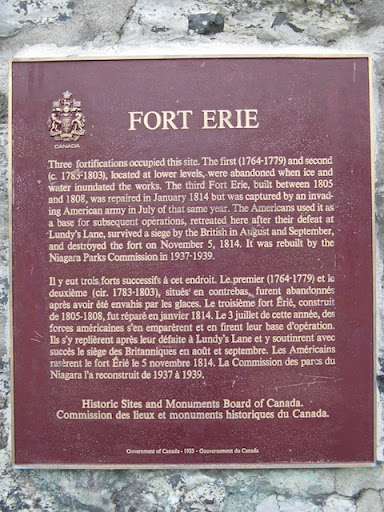
Three fortifications occupied this site. The first (1764-1779) and second (c. 1783-1803), located at lower levels, were abandoned when ice and water inundated the works. The third Fort Erie,...
- toronto
- ontario
- alan brown
The Founding of Shelburne

Settlement of Melancthon Township began in the late 1840's and coincided with the construction of the Toronto-Sydenham Road. By the 1860's settlers had moved into the Shelburne area and in...
- toronto
- ontario
- alan brown
Founding of Carleton Place

The families of Edmond Morphy and William Moore became in 1819 the first settlers on the site of Carleton Place. About 1822 Hugh Boulton built a mill here on the Mississippi River which...
- toronto
- ontario
- alan brown
Founding of Hallowell

Here, on a secure harbour at the head of Picton Bay, several roads converged during the 1790's, including a portage to Lake Ontario. It thus became a natural shipping and distribution centre for...
- toronto
- ontario
- alan brown
Fairfield on the Thames

Here stood the village of Fairfield, destroyed by invading American forces following the Battle of the Thames, 5th October, 1813. Its inhabitants, Delaware Indian exiles brought from Ohio to...
- toronto
- ontario
- alan brown
Founding of Baysville

Surveyed in 1862 by Robert T. Burns, P.L.S., McLean Township was opened for settlement in 1868 under the Free Grants and Homestead Act of that year. The three lots of which much of Baysville...
- toronto
- ontario
- alan brown
The Founding of Sarnia

The French-speaking families of Ignace Cazelet, Jean-Baptiste Paré and Joseph LaForge arrived here 1807-1810. Other settlers, many of Scottish descent, came in 1832-1834 following the 1829 survey...
- toronto
- ontario
- alan brown
The Founding of Palmerston

The opening, in 1871, of a station on the main line of the Wellington, Grey and Bruce Railway, soon to be completed from Guelph to Southampton, provided the nucleus around which a...
- toronto
- ontario
- alan brown
The Founding of Blyth

By 1851, Lucius McConnell and Kenneth McBain, two of the earliest settlers in the area, had located here in Morris Township. Four years later, Donald McDonald laid out a village plot on the...
- toronto
- ontario
- alan brown
First Cheese Factory

The first cheese factory in Canada was established in the County of Oxford, in 1864. The widespread adoption of the cooperative factory system in this and other countries marked the beginning of...
- toronto
- ontario
- alan brown
The First Sault Ste. Marie Canal

The French explorers who first reached this favoured Ojibway hunting and fishing ground were soon followed by fur traders and missionaries who built a post and mission. By 1762 the region had come...
- toronto
- ontario
- alan brown
Fort Chippawa, 1791

The fortifications which stood on this site were built in 1791 to protect the southern terminus of the Niagara portage road, and serve as a forwarding depot for government supplies. Known also as...
- toronto
- ontario
- alan brown
Fort William

When the boundary settlement of 1783 placed its major inland depot, Grand Portage, in U.S. territory, the North West Company was forced to seek a new site on British soil. Following the reopening...
- toronto
- ontario
- alan brown